The short answer
If your furnace won't ignite, blows cold air, cycles on and off, or makes new noises, it likely needs repair. Most problems, like a failed igniter, dirty flame sensor, or bad capacitor, can be fixed. Replacement makes sense mainly for older units with major failures or repeated breakdowns.
Los Angeles winters are mild, but cold nights still come, especially in the valleys and inland neighborhoods where temperatures drop quickly after sunset. When your furnace won't start, blows cool air, or shuts off before the house warms up, Liberty HVAC Services can help. We repair gas furnaces in homes across Los Angeles and nearby cities, and we explain what we find in plain terms before any work begins. This page covers the warning signs to watch for, what a technician checks, how to weigh repair against replacement, and what to expect from a visit.
Signs Your Furnace Needs Repair
Many Los Angeles furnaces sit idle for most of the year, so problems often show up the first time the heat goes on in fall or winter. A dusty smell for the first few minutes after a long break is normal. These symptoms are worth a call:
If you smell gas (a rotten-egg odor), leave the house, don't flip switches or use appliances, and call your gas utility or 911 from outside. If a carbon monoxide alarm sounds, get everyone outdoors and call 911. Those situations come before any repair appointment.
- The furnace won't turn on, or the blower runs but no heat comes out
- The burners light, then shut off after a few seconds or minutes
- Short cycling: the system turns on and off often without reaching the set temperature
- Banging, squealing, scraping, or rattling from the cabinet or ductwork
- Some rooms stay cold while others warm up
- A yellow or flickering burner flame instead of a steady blue one
- Error codes flashing on the control board light
- Heating bills rising without any change in how you use the system
What We Check on a Furnace Repair Visit
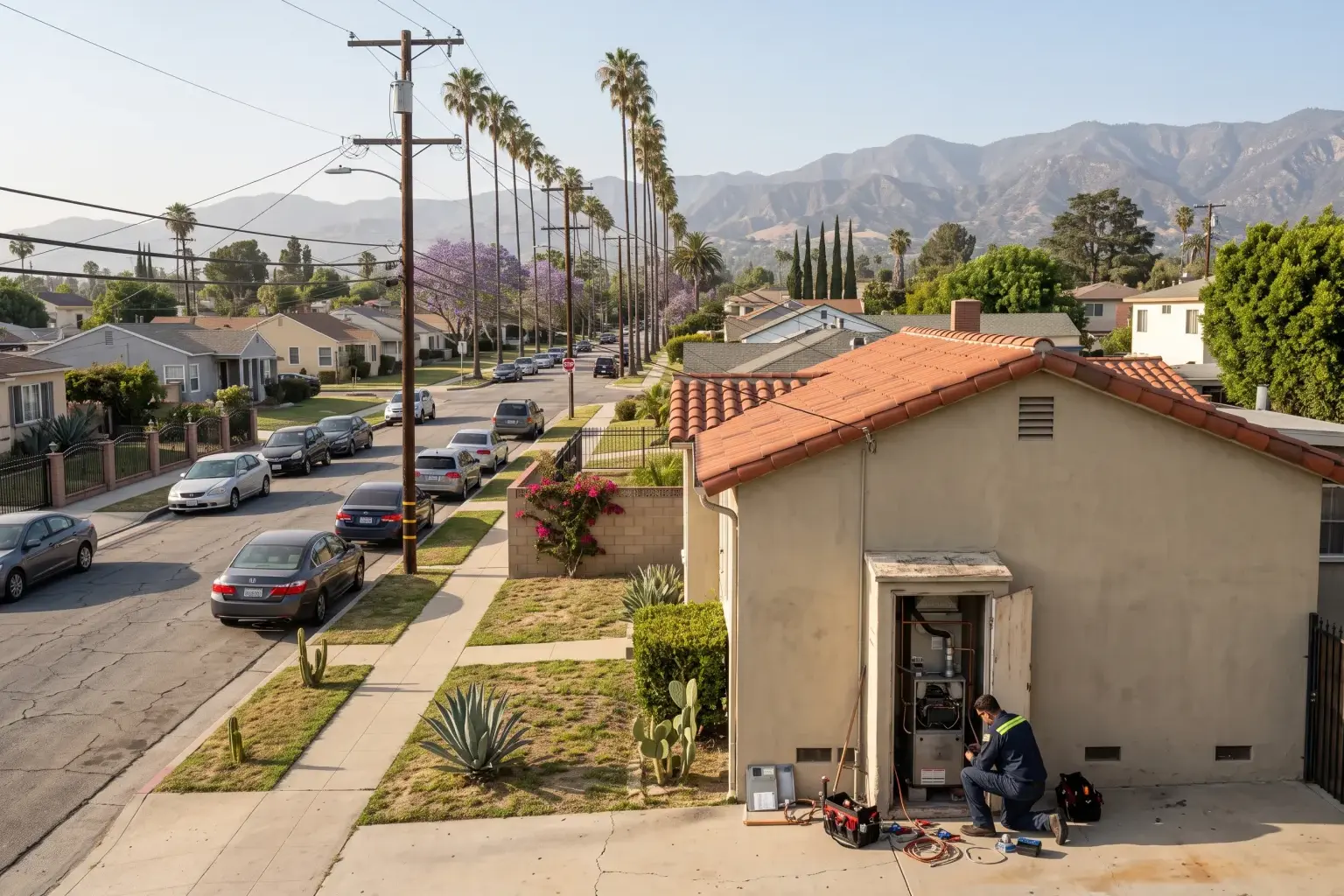
A furnace repair should start with finding the actual cause, not swapping parts until something works. Our technician tests the system while it runs and inspects the components most likely to fail in Southern California homes, where furnaces are often installed in attics, garages, or hall closets.
Attic furnaces deserve extra attention. Summer heat in the valleys and inland areas can be hard on wiring and components in an attic, and dust tends to build up during the long off-season.
- Thermostat settings, wiring, and batteries
- Air filter condition and airflow through the return
- Ignition system, including the hot surface igniter or pilot assembly
- Flame sensor, which can shut the burners off when it's dirty
- Gas valve operation and burner condition
- Draft inducer motor and pressure switch
- Blower motor and capacitor
- Limit switches and other safety controls
- Control board and any stored fault codes
- Heat exchanger, checked for visible cracks or corrosion
- Venting and flue connections, so exhaust leaves the home properly
- Condensate drain and trap on high-efficiency furnaces
Repairing vs. Replacing Your Furnace
Most furnace problems are repairable. A failed igniter, dirty flame sensor, bad capacitor, or clogged filter is a routine fix. Replacement becomes worth discussing when the furnace is older, needs a major part such as a heat exchanger, has needed repeated repairs, or can no longer keep the home comfortable. When both options make sense, we'll show you what we found and lay out each one. The decision is yours.
If you're leaning toward replacement, know the local rules. South Coast AQMD Rule 1111 limits nitrogen oxide emissions from natural-gas central furnaces sold and installed in the Los Angeles region, and the air district has been amending it toward zero-emission requirements. The district sets and revises the compliance dates, so check the current rule before planning a new gas furnace. We factor it into any replacement recommendation.
Some homeowners use a replacement as a chance to switch to a heat pump, which heats and cools with one system. LADWP residential electric customers can apply for Consumer Rebate Program rebates on qualifying heat pump systems, with the amount based on the unit's SEER2 and HSPF2 ratings. The application is filed after the equipment is purchased and installed, within 12 months of purchase. Many homes outside the City of Los Angeles are served by Southern California Edison instead, so available rebates depend on your address; we confirm the current offer before quoting it. The federal Energy Efficient Home Improvement Credit (25C) covered heat pumps placed in service before December 31, 2025, and isn't available for new installations.
What Affects the Cost of Furnace Repair
We can't price a repair until we know what's wrong, but these factors shape the final cost:
You'll get a clear explanation of the recommended repair and its cost before we start. If you'd rather think it over or get another opinion, that's your call.
- Which part failed, and whether it's a common component or a brand-specific one
- How long diagnosis and repair take
- Where the furnace is installed; attic and tight closet units take more time to reach and work on safely
- The furnace's age, make, and model, which affect part availability
- Whether related problems turn up, such as damaged wiring or a blocked vent
- Whether you need an urgent visit outside regular scheduling
How a Furnace Repair Visit Works
Here's what to expect from the time you reach out to the time the heat is back on:
To help the visit go smoothly, clear a path to the furnace and any attic access, and keep pets in another room.
- Schedule: Tell us what the furnace is doing, any error codes or sounds you've noticed, and where the unit is located.
- Arrive and listen: The technician asks a few questions, then looks at the thermostat and the furnace.
- Diagnose: We run the system, test components, and pinpoint the cause.
- Explain: You get a plain-language rundown of the problem, your options, and the cost before any work begins.
- Repair: Once you approve, we make the repair. If the part isn't on hand, we'll tell you when it can be installed.
- Test: We run a full heating cycle, check the safety controls, and confirm warm air is reaching your rooms.
- Wrap up: We clean the work area and share simple upkeep tips, like how often to change your filter.
Furnace Repair by city
- Furnace Repair in West Hollywood
- Furnace Repair in Beverly Hills
- Furnace Repair in Culver City
- Furnace Repair in Inglewood
- Furnace Repair in Santa Monica
- Furnace Repair in Hawthorne
- Furnace Repair in Vernon
- Furnace Repair in Huntington Park
- Furnace Repair in El Segundo
- Furnace Repair in Burbank
- Furnace Repair in Manhattan Beach
- Furnace Repair in Maywood